
Offline vs Cloud Financial Analysis: Which Is Safer and Smarter?
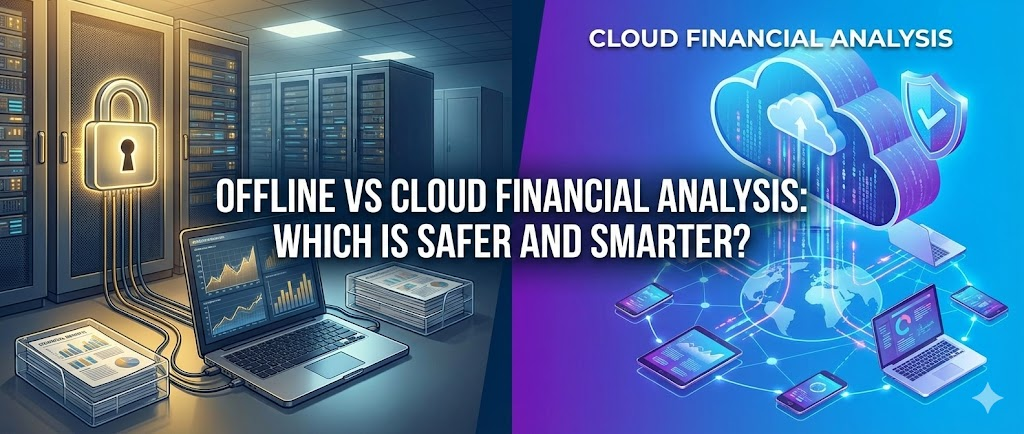
Offline vs Cloud Financial Analysis: Which Is Safer and Smarter?
A practical comparison for privacy-conscious individuals and businesses
Financial analysis tools have evolved rapidly. What once required spreadsheets, manual categorization, and hours of reconciliation can now be completed in minutes with modern software. For most users, cloud-based financial tools have become the default option—promising convenience, automation, and access from anywhere.
But as adoption grows, so do concerns.
Security incidents, regulatory pressure, and increasing awareness of data ownership are prompting users to ask a critical question: Is cloud-based financial analysis really the best long-term choice?
This article explores offline vs cloud financial analysis, compares their strengths and risks, and explains why many individuals and businesses are rethinking where their financial data should live.
Understanding Cloud Financial Analysis
Cloud financial analysis tools work by uploading financial data—such as bank statements, transaction histories, or accounting exports—to remote servers. The analysis is performed on those servers, and insights are delivered through a web or desktop interface.
The advantages are clear:
- Access from multiple devices
- Automatic updates and feature rollouts
- Minimal setup and maintenance
For teams and individuals prioritizing accessibility, this model has been appealing. However, the same architecture that enables convenience also introduces important trade-offs.
The Hidden Trade-Offs of Cloud-Based Tools
1. Reduced Data Control
When financial data is uploaded to a cloud platform, users no longer have direct control over:
- where the data is physically stored
- how long it is retained
- who can access it internally
- how it is backed up or archived
Even with transparent policies, this creates a dependency on third-party practices that users cannot fully verify or manage themselves.
2. Security and Breach Exposure
Cloud platforms store data from thousands or millions of users in centralized systems. While these environments are heavily secured, they also become high-value targets.
A single vulnerability—such as a misconfiguration, leaked credential, or delayed patch—can expose data at scale. For financial information, this risk is particularly concerning due to the sensitivity of the data involved.
3. Compliance and Regulatory Complexity
Financial data is subject to strict privacy and compliance requirements in many regions. Cloud-based processing can involve:
- third-party data processors
- shared infrastructure
- cross-border data transfers
This increases audit complexity and compliance responsibility, especially for professionals handling client data or businesses operating across jurisdictions.
4. Internet and Platform Dependency
Cloud tools rely on:
- stable internet connectivity
- vendor uptime
- active subscriptions
Service disruptions, outages, or account issues can prevent access to financial insights when they are needed most. For critical financial decision-making, this dependency introduces risk.
What Is Offline Financial Analysis?
Offline financial analysis takes a fundamentally different approach.
Instead of uploading data to external servers, all analysis is performed locally on the user’s device. Bank statements and financial records remain on the system and are never transmitted to third parties.
Key characteristics include:
- No internet requirement
- No cloud storage
- No third-party data access
- Full data ownership
Despite operating offline, these tools still provide modern insights such as transaction categorization, trend analysis, and visual summaries—without exposing data beyond the user’s environment.
Offline vs Cloud: A Direct Comparison
Data Privacy
Cloud-based tools require users to trust external platforms with sensitive financial data.
Offline tools eliminate this requirement entirely.
By keeping data local, offline analysis significantly reduces exposure and supports a privacy-first approach.
Security Model
Cloud security is centralized and shared across users.
Offline security is isolated and user-controlled.
Without a shared data repository, offline tools remove the risk of mass data exposure caused by centralized breaches.
Reliability
Cloud tools depend on networks, servers, and vendor infrastructure.
Offline tools work whenever the device is available.
This makes offline analysis more reliable in low-connectivity environments and during service disruptions.
Performance
Offline analysis avoids upload delays and server-side queues. Processing is handled directly by the user’s hardware, which is often faster for individual workloads—especially when working with large statements or frequent analysis.
Compliance
Offline tools simplify compliance by keeping data within the user’s jurisdiction and under direct control. There is no need to evaluate third-party processors or manage complex data transfer considerations.
Why More Users Are Reconsidering Cloud-Only Analysis
The shift toward offline financial tools is not driven by technology limitations—it is driven by trust.
Users are increasingly aware that:
- financial data is highly sensitive
- cloud exposure accumulates over time
- long-term risk matters more than short-term convenience
As awareness grows, so does demand for privacy-first finance tools that prioritize control and responsibility over growth-at-all-costs models.
When Cloud Financial Tools Still Make Sense
Cloud-based analysis is not inherently wrong. It may still be suitable for:
- low-sensitivity personal budgeting
- collaborative workflows requiring shared access
- users who prioritize accessibility over privacy
The key is understanding the trade-offs and choosing based on actual needs—not assumptions.
Why Offline Financial Analysis Is the Smarter Long-Term Choice
For individuals and businesses that value:
- privacy and data ownership
- reliability and independence
- reduced regulatory and security exposure
offline financial analysis offers a future-proof alternative. It aligns with tightening regulations, growing security awareness, and the broader shift toward responsible data handling in financial technology.
How Tools Like Finscope Fit Into This Shift
Offline tools such as Finscope are built around the idea that financial insights should not require financial exposure.
By enabling users to analyze bank statements locally:
- no data is uploaded to the cloud
- no accounts are required
- no external servers are involved
Users retain full control of their financial information while still benefiting from clear, modern analysis. This balance—advanced insights without sacrificing privacy—is what defines the next generation of financial software.
Making the Right Choice
Choosing between offline and cloud financial analysis is not about features alone—it is about priorities.
If accessibility and collaboration are the top concern, cloud tools may be sufficient. If privacy, control, and long-term trust matter, offline financial analysis is the safer and smarter choice.
As finance continues to evolve, tools that respect user ownership and minimize unnecessary risk will shape the future.